
At the turn of the twentieth century, Budapest had more than five hundred coffeehouses. They were not merely places to drink coffee but served as offices for journalists, studios for writers, and meeting rooms for political thinkers. The kavehaz, as Hungarians call it, was woven into the fabric of daily life in a way that few other institutions could match.
Today, many of these historic spaces have been restored to their former splendor. Others have disappeared entirely, surviving only in literature and photographs. This guide covers the most notable coffeehouses still operating in Budapest, places where you can sit with an espresso and feel the weight of more than a century of conversation, creation, and community.
New York Cafe
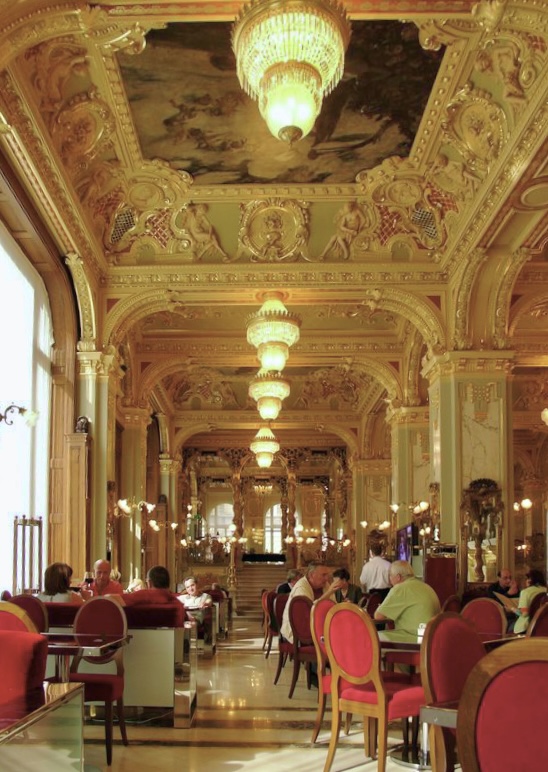
The New York Cafe opened in 1894 inside the headquarters of the New York Life Insurance Company on Erzsebet Boulevard. From its first day, it attracted writers, poets, and editors who took advantage of the free ink and paper provided by the management. The literary magazine Nyugat, which transformed Hungarian literature, held its editorial meetings here.
The interior is a remarkable display of Italian Renaissance-style architecture: gilded columns, elaborate frescoes across the ceiling, and chandeliers of every imaginable shape. After decades of decline during the Communist era, the cafe was restored and reopened in 2006 as part of the Anantara New York Palace Hotel. Today it draws over a thousand visitors daily.
Practical Tip
Arrive early in the morning or on a weekday to avoid the longest queues. While prices are high by Budapest standards, the breakfast menu offers relatively good value given the setting. Expect to pay around 3,500 to 5,000 HUF for a coffee and pastry.
Cafe Gerbeaud

Gerbeaud has occupied its prominent position on Vorosmarty Square since 1858, making it one of the oldest continuously operating confectioneries in Europe. Swiss-born Emil Gerbeaud took over in 1884 and transformed it into a destination for the finest pastries and chocolates in the Austro-Hungarian Empire.
The cafe is known particularly for its Dobos torte, a layered sponge cake with chocolate buttercream and a distinctive caramel top. The interior retains much of its original character: wood paneling, crystal chandeliers, and marble tabletops. Unlike the New York Cafe, Gerbeaud feels more like an active part of Budapest's daily life than a museum piece.
What to Order
Beyond the famous Dobos torte, try the konyakos meggy (brandy cherry bonbons) and the seasonal fruit tarts. The espresso here is solid and well-extracted, served in proper porcelain cups. For a fuller experience, order the Gerbeaud slice, a walnut and apricot jam pastry that carries the house name.
Ruszwurm Confectionery

Ruszwurm is the oldest confectionery in Budapest, established in 1827 on Szentharomsag Street in the Castle District. With just a handful of small tables and original Biedermeier-era furniture, it feels genuinely unchanged from the nineteenth century. The space is tiny, which only adds to its charm and authenticity.
The confectionery is famous for its kremeschnitte (cream slice), a Hungarian take on the custard-filled pastry found across Central Europe. It also serves excellent traditional cakes and strong Hungarian espresso. Empress Elisabeth of Austria, known as Sisi, was reportedly a regular visitor during her stays at the nearby Royal Palace.
Practical Tip
Ruszwurm has very limited seating, so be prepared to wait during peak hours. Visiting in the late morning on a weekday is your best chance for a table. The kremeschnitte sells out on busy days, so ask about availability when you arrive.
Central Cafe (Central Kavehaz)

The Central Cafe on Karolyi utca has been serving coffee since 1887. Like the New York Cafe, it was a gathering place for writers and intellectuals. The poet and novelist Frigyes Karinthy was a regular, and the cafe appeared in works by several Hungarian literary figures. After closing during the Communist period, it reopened in 2000 and has maintained a quieter, more studious atmosphere than some of its grander competitors.
The interior combines high ceilings, large windows, and dark wood furnishings that create a feeling of comfortable elegance without the overwhelming ornamentation of the New York Cafe. The coffee menu covers standard Hungarian-style espresso drinks alongside a small selection of specialty options. The pastry case features traditional Hungarian desserts alongside Viennese-influenced selections.
The Coffeehouse Tradition in Context
To understand why these coffeehouses matter, it helps to know a little about their role in Hungarian history. In the decades before World War I, Budapest's coffeehouses served as informal newsrooms, literary salons, and political meeting rooms. Many Hungarian writers produced their most important works at cafe tables, and some editorial offices were essentially just a reserved table and a regular delivery of proofs.
The tradition declined sharply after 1945. The Communist government viewed independent gathering places with suspicion, and many coffeehouses were converted to other uses or simply closed. The revival began in the 1990s, and the last two decades have seen careful restorations that balance historical authenticity with the demands of modern hospitality.
For those interested in the broader history, the Museum of Applied Arts in Budapest has periodic exhibitions on coffeehouse culture, and the Hungary Today portal regularly covers cultural heritage topics.
| Coffeehouse | Founded | District | Best For |
|---|---|---|---|
| New York Cafe | 1894 | VII (Erzsebetvaros) | Architecture, atmosphere |
| Cafe Gerbeaud | 1858 | V (Belvaros) | Pastries, central location |
| Ruszwurm | 1827 | I (Castle District) | Authenticity, kremeschnitte |
| Central Cafe | 1887 | V (Belvaros) | Quiet reading, literary history |

